Experimental vision-restoring therapy for retinitis pigmentosa reaches clinical milestone
A novel experimental therapy developed from foundational research at the University of Washington Department of Ophthalmology has reached an important clinical milestone, with results from a first-in-human study published on April 14 in Nature Medicine. The paper reports early clinical findings for KIO-301, a light-activated small molecule designed to ultimately restore some vision in people with advanced retinitis pigmentosa. This rare inherited disease causes progressive vision loss.
Russell N. Van Gelder, MD, PhD, Boyd K. Bucey Professor and Chair of the Department of Ophthalmology in the UW School of Medicine, who co-authored the paper, helped develop the underlying science behind this approach. The technology is based on a class of compounds known as molecular photoswitches, which can confer light sensitivity to surviving retinal cells after photoreceptors have been lost. Photoswitches are effectively nanometer-scale light switches that can turn drug activity on and off with light. KIO-301 targets voltage-gated potassium channels, which control neuronal firing.
“The science of molecular photoswitches has come a long way from its beginnings in basic research pioneered by my colleagues Dirk Trauner and Rich Kramer at the University of California, Berkeley, as well as our lab at the University of Washington,” Dr. Van Gelder said. “It is very gratifying to see the first steps in translating this remarkable technology to clinical use. We look forward to seeing, with additional trials, whether these early signals translate into consistent functional vision benefit.”
The Phase 1 ABACUS-1 study, led by collaborator Dr. Robert Casson at the University of Adelaide in Australia, enrolled six participants with late-stage retinitis pigmentosa and evaluated 12 treated eyes. Investigators reported that the primary endpoint of short-term ocular and systemic safety was met, with no serious adverse events, dose-limiting toxicities, drug-related intraocular inflammation, or structural retinal changes attributable to treatment.
Researchers also reported exploratory findings suggesting clinical activity. Participants showed improvements in light perception and functional vision measures after dosing. Functional MRI demonstrated light-induced changes in visual cortex activity consistent with the drug’s expected window of activity, and patient-reported quality-of-life scores improved during the study period. The investigators emphasized that larger, controlled trials will be needed to determine whether these signals translate into reliable improvements in day-to-day vision.
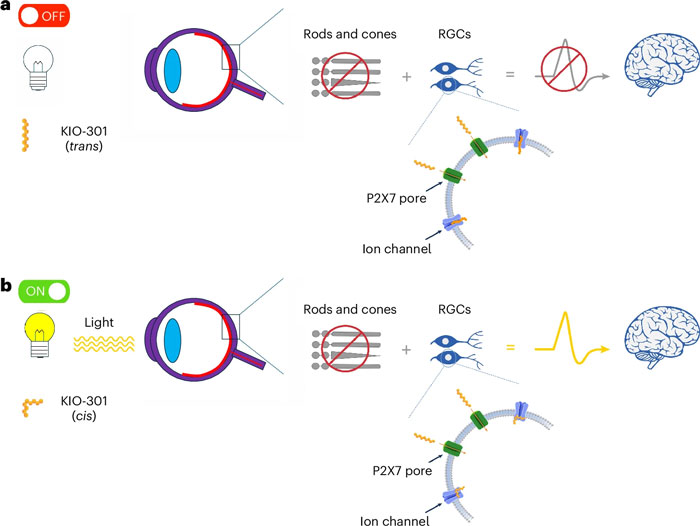
KIO-301 is designed to work independently of the specific genetic mutation underlying retinal degeneration, potentially making the approach relevant to a broad range of patients with outer retinal disease. The small molecule contains a light-reactive azobenzene group. It is intended to enter retinal ganglion cells, making ion channels in those cells responsive to light and enabling signals to be sent to the brain even after photoreceptors are lost.
For Dr. Van Gelder, the publication represents both a scientific and translational milestone.
“This publication reflects over 20 years of work aimed at turning a powerful concept in pharmacologic neuroscience into something that may ultimately help patients,” he said. “For people with advanced retinal degeneration, the need for mutation-agnostic restorative therapies is enormous.”
Based on the Phase 1 findings, the developers of KIO-301 have launched ABACUS-2, a randomized, controlled Phase 2 trial evaluating higher doses and functional vision outcomes.
Retinitis pigmentosa affects people worldwide and is characterized by the gradual loss of photoreceptors, often progressing to severe visual impairment or blindness. Current treatment options remain limited for patients with advanced disease, making restorative approaches an area of intense research interest.
Schematic below from Nature Medicine showing effect of photoswitch compound (KIO-301) to restore light sensitivity to retinal ganglion cells in eyes with advanced retinitis pigmentosia (RP). Light causes isomerization of KIO-301 which results in blockage of voltage-gated ion channels, resulting in depolarization of cells and firing. The recently published paper demonstrated that the drug was safe in individuals with advanced RP treated with drug, and restored some light and vision responses in some subjects.