

The Robert M. Sinskey MD Foundation: Advancing vision science through transformational partnership
The Robert M. Sinskey MD Foundation was established a few years before Dr. Sinskey’s death, with his three children and a close friend and advisor entrusted to its board. Dr. Sinskey—a distinguished ophthalmologist known for both innovation and compassion—gave them a broad and forward‑looking mission: to advance medical science and patient care through research, clinical excellence, and education.
In honoring that charge, the board chose to focus primarily on ophthalmology, the field to which Dr. Sinskey devoted his life. Their vision has resulted in a deep and enduring investment in the research mission of the UW Medicine Department of Ophthalmology.
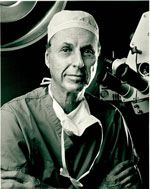
“We are proud to continue Dr. Sinskey's legacy by supporting Dr. Van Gelder and his research team,” said Pat Wynn, president of the Sinskey Foundation. “UW Ophthalmology research mirrors Dr. Sinskey’s approach to advancing medical care through cutting‑edge design and worldwide impact.”
Dr. Sinskey was an internationally sought‑after lecturer and surgeon, renowned for his surgical skill and commitment to teaching. He founded the Foundation for Ophthalmic Education to bring physicians from around the world to learn the techniques of phacoemulsification—a cataract procedure that, while standard today, was initially met with significant skepticism. He later designed an intraocular lens that became the most widely used lens globally for more than a decade. Among his other accomplishments is the Sinskey Hook, a surgical instrument still in routine use around the world.
Today, the Sinskey family continues that legacy by supporting cutting-edge research and clinical advances that are shaping the future of eye care.

“Many of the most significant research initiatives in our department have been made possible by the Sinskey family,” said Dr. Russ Van Gelder, Bucey Chair of the Department of Ophthalmology. “Most recently, their partnership has fueled research into sequencing DNA to capture both genetic and epigenetic information, offering a far more complete picture of the inheritance of retinoblastoma—work that has significant implications for diagnosis and treatment.”
Funding from the Sinskey Foundation has strengthened research across the department, driving progress in areas such as:
- accelerating discoveries in glaucoma prevention and treatment
- developing early detection strategies for retinal disease
- applying artificial intelligence to diagnose ocular melanoma
- advancing understanding of gene‑therapy–associated uveitis
- improving strategies for corneal wound healing
- identifying disease‑causing gene mutations in Type 2 Usher syndrome
“Support from the Sinskey Foundation not only meets immediate research needs—it also provides critical funding that positions our faculty to pursue larger, long‑term projects,” Van Gelder added. “In many cases, the foundation’s early investment has helped our vision scientists secure substantial additional support from NIH and other sources. Their partnership has been truly transformational.”